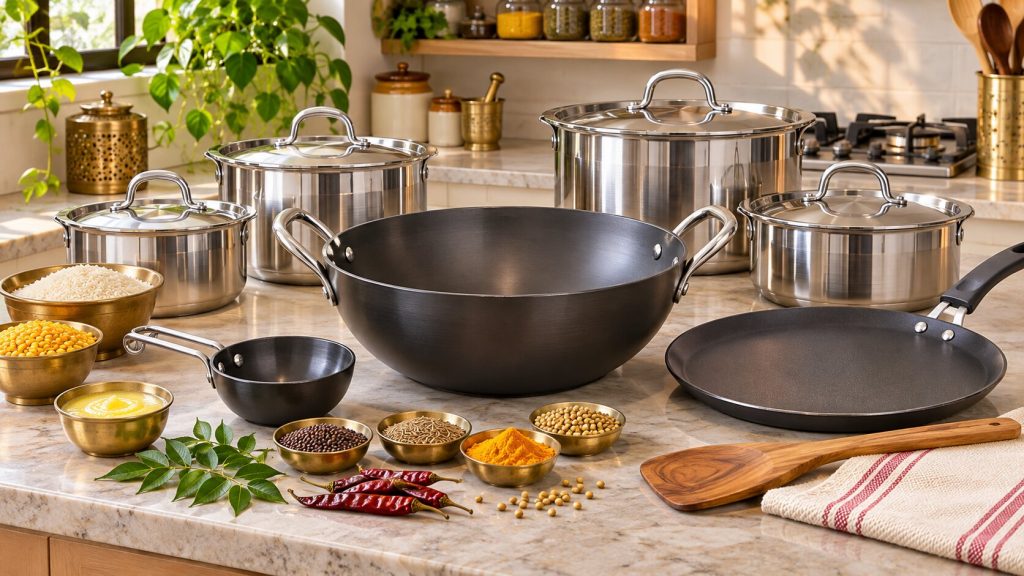
Indian home cooking asks a lot of a pan. One burner is boiling milk, another is holding a dal at a slow simmer, and a third is about to take a tadka of cumin in hot ghee that needs to go from cold to sputtering in under a minute. Cookware that can’t respond quickly to heat changes will fight you every evening.
The full list fits on one shelf. Most Indian kitchens run on four or five vessels, and once you have them, you can make almost anything.
The kadai first
If you buy one thing, buy a kadai. The deep bowl shape concentrates heat at the base, which is what you want for sautéing onions down to brown, finishing a sabzi, or deep-frying without oil creeping up the sides and over the rim. Shallow pans are the main reason home frying turns messy.
Depth matters more than people expect. Oil expands and foams when wet batter hits it, so a pan that looks adequate when cold can overflow when you drop in the second batch of pakoras.
Capacity is the other decision. A 2 to 2.5 litre kadai is comfortable for two to four people, and a 4 litre version (roughly 28cm across) handles five or six servings or batch cooking you plan to freeze. Anything under a litre is a sides-and-reheating vessel, not a curry pot.
Topes and pateelas
A tope, the straight-sided lidded pot, does the quiet work: rice, dal, milk, tea, soaking and boiling. Having three in graduated sizes (something like 33, 47 and 60 ounces) covers nearly every daily task without constantly washing the same pot twice.
Look for lids that sit flush. A loose lid lets steam escape, and that steam is doing the cooking in rice and in any covered simmer.
Flat bottoms and cooktops
Traditional round-bottom kadhais sit perfectly on a gas ring and wobble on everything else. On a flat electric or induction surface they need a wok ring, which is one more thing to store.
Induction is stricter still. The pan needs a flat, ferromagnetic base, which in practice means tri-ply stainless steel or a model with an induction disc bonded underneath. Hard-anodized aluminium nonstick usually won’t register on an induction hob at all, so if you cook on induction or expect to switch, check the specifics against how Basil Carmel’s guide describes base construction across different kadai styles before committing to one. A magnet on the bottom of the pan settles the question in two seconds.
Steel or nonstick
This is the question most people get stuck on, and both answers are defensible.
- Tri-ply stainless steel (steel, aluminium core, steel) spreads heat without hot spots, which matters for a curry that sits on low heat for forty minutes. It works on every cooktop and has no coating to wear out.
- Food-grade 18/8 stainless steel won’t react with tamarind, tomato or lemon, so an acidic gravy tastes the way it should.
- Hard-anodized aluminium nonstick heats faster, needs less oil, and resists scratching better than ordinary nonstick. A 2.5 litre hard-anodized kadai is light enough to toss food in one hand.
- Nonstick coatings are a consumable. With heavy daily use, expect to replace the pan every five to seven years, sooner if metal spoons or repeated high heat get involved.
Steel has a learning curve of about a week. Preheat the pan over medium for a minute or two, add oil and wait for it to shimmer, then add your ingredients and leave them alone. Food releases on its own once a light crust forms. Poking at it early is what makes people declare steel impossible.
Handles and lids
Handle design follows the technique. One long handle suits stir-frying and tossing; two short side handles are safer when you’re carrying three litres of hot oil to the sink or lifting a loaded pan off the flame.
Rosewood stays cool longest but wants occasional oiling. Plastic warms up during sustained high-heat work, though it’s cheap to replace. Either way, riveted handles outlast welded ones, which can loosen under repeated strain.
A lid should come with the pan rather than be improvised later. Stainless lids hold heat for covered simmering; a glass lid lets you watch rice without lifting it. A no-drip flange on the rim is a small feature that saves a lot of gravy down the side of the pot.
Daily maintenance
Steel is low-effort. Wash it warm and soapy, dry it right away so water spots don’t set, and use baking soda paste or a dedicated steel cleanser on burnt residue. No seasoning, no conditioning.
Skip steel wool on polished surfaces. Soft sponges and wooden or bamboo utensils keep both the mirror finish and a nonstick coating intact.
Check one thing before you buy: a pan that looks right in the display will feel different when it’s holding four litres of biryani. Pick it up, imagine it full, and make sure you can lift it off the heat with one hand on each handle.